
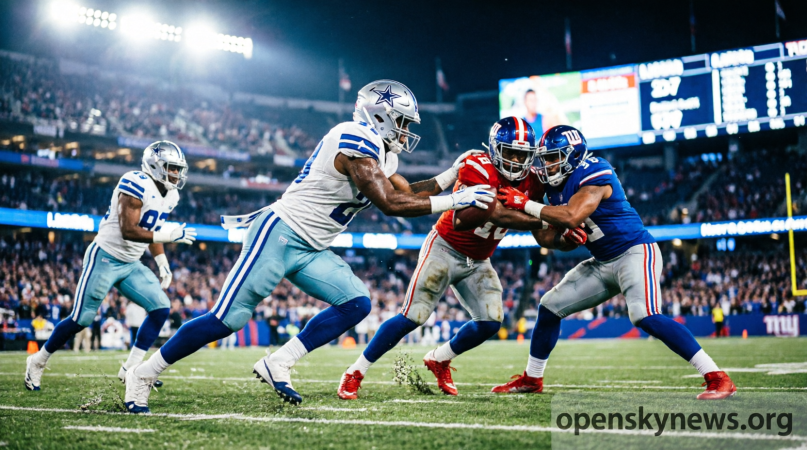
The Dallas Cowboys vs New York Giants match player stats highlight quarterback performances, rushing yards, receiving numbers, defensive plays, and team comparisons. The game featured key contributions from Dak Prescott, Jaxson Dart, CeeDee Lamb, Javonte Williams, and Cam Skattebo. These statistics help explain how both teams performed and which players influenced the final score.
Introduction
The Dallas Cowboys and New York Giants met on September 13, 2026, at MetLife Stadium. The Giants won the NFL regular-season game by a score of 28–20. New York gained 394 total yards, while Dallas finished with 244 yards. This difference helped explain why the Giants controlled more of the game.
The Dallas Cowboys vs New York Giants match player stats highlight several strong performances. Jaxson Dart threw three touchdown passes for New York. Dak Prescott threw two touchdown passes for Dallas. Cam Skattebo led the Giants in rushing, while Isaiah Likely led their receivers.
This article covers the final score, player statistics, family background where relevant, and the key moments of the game. Each topic has its own section. The focus remains on verified game information and useful details for NFL fans.
Dallas Cowboys vs New York Giants Final Score
The New York Giants defeated the Dallas Cowboys 28–20. The game took place during Week 1 of the 2026 NFL regular season. New York scored seven points in every quarter. Dallas scored seven points in the second and third quarters, then added six points in the fourth.
Official Site of the Dallas Cowboys
The Giants built their lead early and continued scoring throughout the game. Dallas remained within reach but could not produce enough points to take control. The final score reflects New York’s stronger offensive output.
| Game detail | Result |
|---|---|
| Match | Dallas Cowboys vs New York Giants |
| Date | September 13, 2026 |
| Venue | MetLife Stadium |
| Final score | Giants 28, Cowboys 20 |
| Competition | NFL regular season |
Complete Cowboys vs Giants Box Score
The team box score shows a clear difference in offensive production. New York gained 229 passing yards and 165 rushing yards. Dallas recorded 175 passing yards and 69 rushing yards. The Giants also finished with more first downs.
| Team statistic | Dallas Cowboys | New York Giants |
|---|---|---|
| Final score | 20 | 28 |
| Total offensive yards | 244 | 394 |
| Passing yards | 175 | 229 |
| Rushing yards | 69 | 165 |
| First downs | 21 | 29 |
| Turnovers | 1 | 1 |
New York gained 150 more total yards than Dallas. It also recorded eight more first downs. Both teams had one turnover, so the difference was not simply the number of mistakes. The Giants moved the ball more effectively and turned their opportunities into points.
Dak Prescott Passing Stats
Dak Prescott completed 22 of 34 passes for 175 yards. He threw two touchdown passes and one interception. His completion percentage was about 64.7%. These Dak Prescott passing stats show that he made several successful throws but did not produce as much passing yardage as Jaxson Dart.
Prescott helped Dallas score twice through the air. However, the interception ended a possession and gave the Cowboys one fewer chance to score. Dallas also struggled to gain yards on the ground, which limited its offensive balance.
Prescott’s performance should be judged through several measures. Passing yards, touchdowns, interceptions, and completion percentage all provide useful context. No single statistic explains a quarterback’s entire performance.
Jaxson Dart Passing Stats
Jaxson Dart completed 23 of 29 passes for 230 yards. He threw three touchdown passes and did not record an interception. His completion percentage was about 79.3%. These numbers made him one of the leading performers in the game.
Dart gained 55 more passing yards than Prescott despite attempting fewer passes. He also threw one additional touchdown. His accurate passing helped New York maintain drives and create scoring chances.
Dallas managed to sack Dart twice, but the Giants still finished with 229 team passing yards. Dart’s combination of accuracy and ball security played a major role in the victory.
Dak Prescott and Jaxson Dart Comparison
The quarterback comparison shows why New York’s passing attack was more productive. Prescott threw two touchdowns and one interception. Dart threw three touchdowns without an interception. Dart also gained more yards on fewer attempts.
| Passing statistic | Dak Prescott | Jaxson Dart |
|---|---|---|
| Completions | 22 | 23 |
| Attempts | 34 | 29 |
| Passing yards | 175 | 230 |
| Completion percentage | 64.7% | 79.3% |
| Touchdown passes | 2 | 3 |
| Interceptions | 1 | 0 |
Dart averaged 7.9 yards per attempt, compared with Prescott’s 5.1. This difference shows that Dart gained more yardage from each pass attempt. Both quarterbacks helped their teams score, but Dart produced the stronger passing performance.
Javonte Williams Rushing and Receiving
Javonte Williams contributed in both the running and passing games for Dallas. He carried the ball 12 times for 41 yards and one rushing touchdown. He also caught five passes for 31 yards and another touchdown. His two touchdowns made him one of Dallas’s most productive offensive players.
Williams averaged about 3.4 yards per rushing attempt. His numbers show that Dallas struggled to produce consistent gains on the ground. The Cowboys finished with only 69 rushing yards as a team.
His receiving work gave Prescott another option during passing plays. Still, Williams could not make up for the team’s lower total yardage. Dallas needed more production from its ground game to match New York’s offense.
Cam Skattebo Rushing Performance
Cam Skattebo led the Giants in rushing. He carried the ball 18 times for 81 yards and one touchdown. He averaged 4.5 yards per carry. His rushing performance helped New York maintain a balanced offense.
Skattebo gained 40 more rushing yards than Williams. He also averaged more yards per carry. His touchdown gave the Giants another way to score without relying only on passing plays.
Jaxson Dart added 54 rushing yards on 11 carries. Devin Singletary gained 16 yards, while Tyrone Tracy Jr. added 14 yards on two carries. Together, the Giants’ runners helped the team reach 165 rushing yards.
CeeDee Lamb Receiving Stats
CeeDee Lamb led Dallas in receiving yards. He caught five passes for 44 yards and one touchdown on eight targets. His longest reception covered 15 yards. His performance gave the Cowboys an important scoring option.
Lamb’s touchdown helped Dallas stay competitive. However, he finished with fewer than 50 receiving yards. This limited the Cowboys’ ability to gain large amounts of yardage through their main receiving option.
Javonte Williams caught five passes for 31 yards. George Pickens recorded three receptions for 28 yards, while Ryan Flournoy added two catches for 22 yards. Dallas spread the ball among several players but could not match the Giants’ total passing production.
Isaiah Likely Receiving Stats
Isaiah Likely led the Giants’ receivers with eight catches for 78 yards and two touchdowns. He received eight targets and caught every pass thrown his way. His longest reception covered 19 yards. His receiving touchdowns helped New York build its lead.
Malik Nabers also contributed with six receptions for 69 yards on nine targets. His performance gave Dart another productive option. The Giants did not depend on one receiver to gain all their passing yards.
Darnell Mooney caught two passes for 27 yards. Malachi Fields added 25 receiving yards, while Devin Singletary caught a touchdown pass. These contributions helped New York finish with 229 passing yards.
Defensive Player Statistics
Defensive statistics help show how players tried to stop the opposing offense. Donovan Ezeiruaku recorded 10 tackles and half a sack for Dallas. Jalen Thompson made nine tackles, while Caleb Downs recorded eight tackles and a sack. These performances showed that Dallas created some pressure despite losing.
For New York, Tremaine Edmunds recorded eight tackles. Arvell Reese made five tackles and recorded a tackle for loss. Deonte Banks added four tackles and defended two passes. Jevon Holland recorded an interception.
Tackles, sacks, and interceptions measure different parts of defensive performance. A sack shows pressure on the quarterback, while an interception ends the opposing team’s possession. These statistics are most useful when reviewed alongside total yards allowed and points conceded.
Turnovers and Game-Changing Plays
Both teams recorded one turnover. Prescott threw an interception, while the Giants’ defensive statistics credited Jevon Holland with an interception. This left the turnover count level between the teams.
Dallas also created pressure against Dart. Caleb Downs recorded a sack, and the Cowboys produced a forced fumble during the game. These plays disrupted New York’s offense but did not stop the Giants from gaining 394 yards.
Turnovers can change a game’s direction, but they do not explain every result. The Giants gained more yards and recorded more first downs. Their stronger offensive production helped them overcome the Cowboys’ defensive efforts.
Team Offense and Total Yards
New York finished with 394 total offensive yards, while Dallas gained 244. The Giants produced more passing yards and more rushing yards. This balance gave their offense several ways to move the ball.
Skattebo led the rushing attack, Dart passed for 230 yards, and Likely scored twice as a receiver. These individual performances worked together to create a productive team effort.
Dallas had its own scoring plays, but its 69 rushing yards limited its offensive balance. The Cowboys also finished with fewer passing yards. Their lower total yardage made it harder to keep pace with New York.
Quarter-by-Quarter Scoring Summary
The Giants scored seven points in each quarter. Dallas did not score in the first quarter but added seven points in both the second and third quarters. The Cowboys scored six points in the fourth quarter. New York’s steady scoring helped it protect the lead.
| Quarter | Dallas Cowboys | New York Giants |
|---|---|---|
| First | 0 | 7 |
| Second | 7 | 7 |
| Third | 7 | 7 |
| Fourth | 6 | 7 |
| Final score | 20 | 28 |
The opening quarter gave New York an early advantage. Dallas responded in the next two quarters but could not close the gap. The Giants continued to score, which forced Dallas to chase the result.
Time of Possession and Third-Down Conversions
Time of possession measures how long a team controls the ball. Third-down conversions show how often an offense gains enough yards to continue a drive. Both figures help explain how a team maintains possession and creates scoring chances.
The Giants recorded 29 first downs, compared with Dallas’s 21. They also gained 150 more total yards. These figures support the conclusion that New York sustained more offensive activity during the game.
Exact time-of-possession and third-down conversion figures should come from a verified box score. They should not be estimated from the final score alone. Together with first downs and total yards, these measures help readers understand how each team managed its drives.
Players’ Personal Background and Privacy
Player biographies can provide useful context, but they should remain separate from match statistics. Dak Prescott and Jaxson Dart have different family backgrounds and career paths. Those details do not change the passing yards, touchdowns, or interceptions recorded in this game.
Prescott was born in Sulphur, Louisiana, on July 29, 1993. He is the son of Peggy Prescott and Nathaniel Prescott. He has two older brothers, Tad and Jace, and an older half-brother, Elliott Prescott. Prescott has also spoken publicly about the influence of his mother and family on his life.
Jaxson Dart was born on May 13, 2003, in Kaysville, Utah. His parents are Brandon and Kara Dart. He grew up playing multiple sports before focusing on football. Personal information about players and their relatives should be included only when it is publicly documented and relevant.
Family details should not be mixed with unsupported claims about private relationships or home life. A responsible player profile focuses on verified birth details, parents, siblings, education, and career milestones. It avoids speculation about private matters.
Conclusion
The Dallas Cowboys vs New York Giants match player stats explain how New York earned its 28–20 victory. Jaxson Dart threw three touchdown passes, Cam Skattebo gained 81 rushing yards, and Isaiah Likely caught two touchdown passes. Their combined performance helped the Giants gain 394 total yards.
Dallas also had strong individual moments. Prescott threw two touchdown passes, and Williams scored twice. However, the Cowboys finished with fewer total yards and struggled to produce consistent rushing gains.
The game shows why a full box score matters. Passing yards, rushing yards, receiving touchdowns, turnovers, and defensive statistics provide a clearer picture than the final score alone.
Frequently Asked Questions
1. Who won the game?
The New York Giants defeated the Dallas Cowboys 28–20 on September 13, 2026.
2. Who led in passing yards?
Jaxson Dart led with 230 passing yards, three touchdowns, and no interceptions.
3. Who led in rushing yards?
Cam Skattebo led the Giants with 81 rushing yards and one touchdown.